
AI and medical coding: where professional judgment is still essential
Artificial intelligence is transforming the healthcare revenue cycle. At the same time, recent decisions by the AMA and CMS point in a clear direction: as technology takes on more tasks, human knowledge moves toward interpretation, validation, and decision-making.
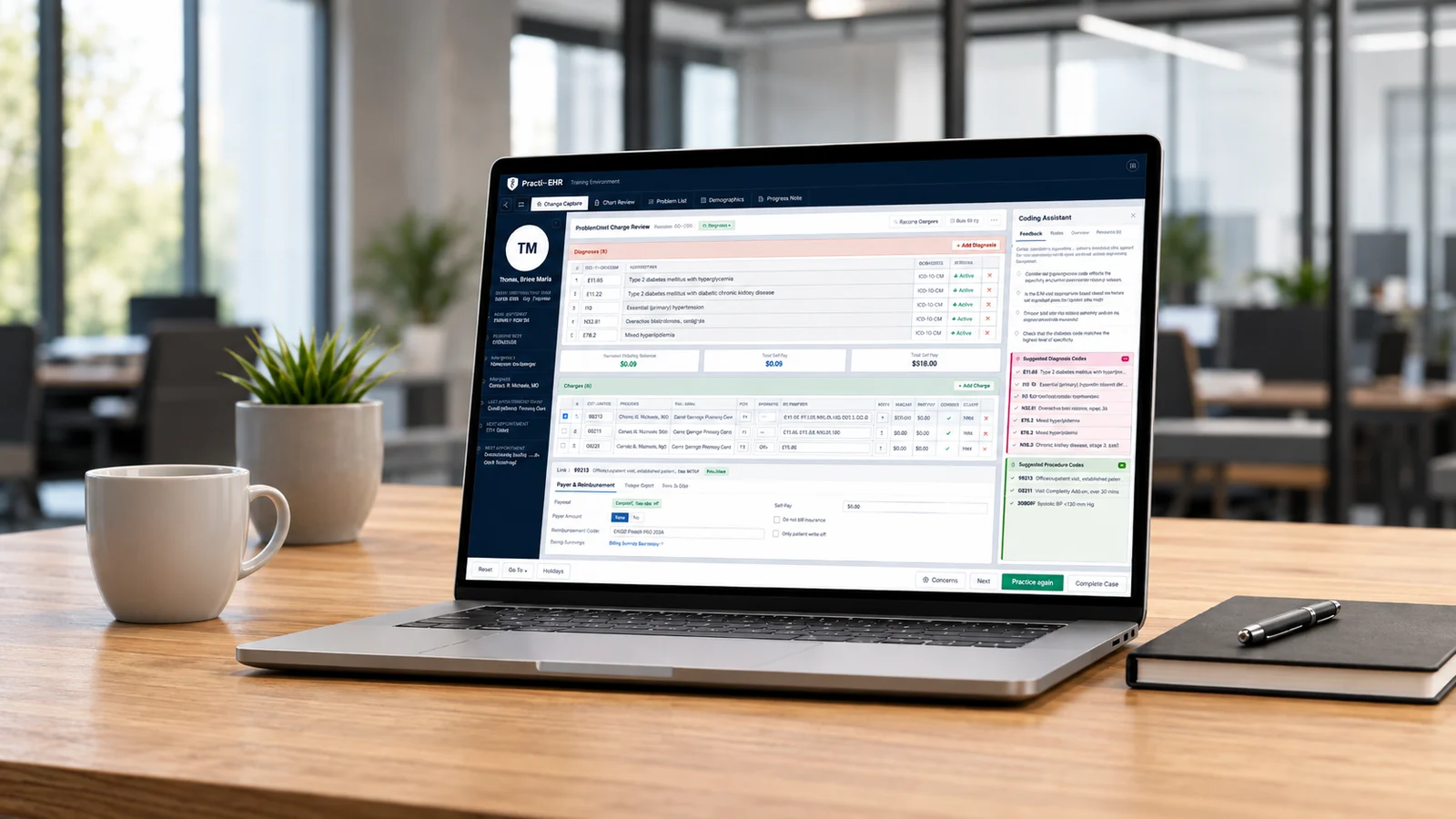
There is a question that comes up often among people considering a career in medical coding: if software can suggest codes, what place does the credentialed professional hold?
The answer is starting to take shape inside the industry itself.
Over the past few years, the American Medical Association and the Centers for Medicare & Medicaid Services have built artificial intelligence into clinical, administrative, and reimbursement frameworks. And in doing so, they have also defined something important: technology can extend the system’s capacity, while professional judgment keeps playing a central role in interpretation, oversight, and validation.
For those preparing to earn a credential such as the CPC, this shift opens up a particularly interesting view. The future of medical coding seems to be less about memorizing codes and more and more about understanding why a code applies, how to support it, and when a situation calls for further analysis.
The AMA is already defining how artificial intelligence takes part in care
Since January 1, 2022, the CPT® code set has included Appendix S, a taxonomy developed to classify artificial intelligence applications by the level of involvement of the technology and of the healthcare professional.
The AMA organizes these applications into three broad categories:
- Assistive — The technology provides clinically relevant information that then requires interpretation and reporting by a physician or other qualified health care professional.
- Augmentative — The system analyzes information and generates additional output, such as scales, indices, classifications, or risk scores that complement professional judgment.
- Autonomous — The technology can interpret information and reach conclusions independently, with different levels of oversight established within the classification itself.
This structure reflects an important shift.
Artificial intelligence is starting to be formally built into health services, while professional interpretation continues to form part of the framework used to describe, document, and report many of those services.
The CPT® Editorial Panel has also kept refining Appendix S, with new clarifications set to take effect on January 1, 2027.
In other words, the relationship between technology and professional work is being defined with more precision as the industry moves forward.
Source: American Medical Association — CPT® Appendix S, AI taxonomy (effective January 1, 2022).
CMS is also combining technology with clinical review
On January 1, 2026, the CMS Innovation Center’s WISeR model began, an initiative related to prior authorization for certain services within Original Medicare.
The model runs through December 31, 2031 and starts out in six states: New Jersey, Ohio, Oklahoma, Texas, Arizona, and Washington.
CMS’s own description sums up the direction of this shift well:
“Artificial intelligence (AI) and machine learning (ML), along with human clinical review.”
That principle is especially relevant.
Technology makes it possible to analyze large volumes of information and support administrative processes at greater scale. At the same time, the program’s structure builds human clinical review into decisions related to coverage.
For people working in medical coding and revenue cycle, this shift has a practical consequence: the quality of the documentation and the ability to support every code matter even more.
A code can be identified by a system. Understanding whether it is backed by the documentation, the guidelines, and the specific circumstances of the encounter takes an additional layer of reasoning.
New opportunities are appearing around validation
That layer of analysis is already part of many roles within the revenue cycle: denials management, appeals, coding audits, clinical documentation review, risk adjustment, and physician queries.
In these areas, the professional value lies in connecting three things: the clinical documentation, the coding rules, and the payer’s requirements.
Technology can speed up finding information. The prepared professional brings context, interpretation, and judgment.
Sources: CMS Innovation Center — WISeR model (2026) · CMS — WISeR Model Provider and Supplier Operational Guide.
Medical coding keeps evolving every year
Another fundamental feature of this profession is constant change.
The main code sets used in the United States are updated regularly and follow different calendars.
418
changes in CPT® 2026
487
new ICD-10-CM codes for FY 2026
2
update calendars every year
For 2026, CPT® added 288 new codes, 84 deletions, and 46 revisions, effective January 1, 2026.
ICD-10-CM FY 2026, for its part, added 487 new codes, along with revisions and codes that are no longer valid, effective October 1, 2025.
This means the professional works inside a moving environment.
A correct decision depends on the applicable code set, the date of service, the applicable guidelines, the documentation available, and the specific features of each encounter.
That is precisely why professional development in medical coding goes well beyond learning a list of codes. It is about learning to navigate a system that keeps evolving.
Sources: American Medical Association — CPT® 2026 code set (press release) · CMS — ICD-10-CM update for fiscal year 2026 (effective October 1, 2025).
AI itself is already part of the language of CPT®
There is another significant change.
CPT® 2026 adds new Category I codes related to services that use augmentative software, including applications for analyzing coronary atherosclerotic plaque.
That is an important moment for the industry.
Artificial intelligence is moving from being only an experimental technology to being built into clinical services that have formal reporting and reimbursement structures.
For medical coders, this shift creates a new dimension of knowledge: understanding how services that incorporate advanced technology are documented, classified, and reported.
The coder’s role is moving toward validation
The work is changing too.
More and more often, part of the workflow starts with a recommendation generated by software. From there, the professional may have to:
- review the documentation
- confirm the code selection
- resolve ambiguous scenarios
- identify clinical information that needs clarification
- apply guidelines
- support a claim during audits, denials, or appeals
That shift favors a skill that has always been at the center of good medical coding: judgment.
Technology can make certain tasks faster. Professional knowledge is what turns that speed into reliable information.
What automation does not settle
As in many industries, the detail of the craft and the responsibilities will keep evolving with the technology. What does not change is who answers when the code has to hold up in front of a payer.
What matters for someone starting today is building skills that can travel with that evolution.
Preparing for the CPC means learning to make decisions
The CPC exam is a good representation of that professional reality.
The goal goes well beyond recalling a code. Candidates have to interpret clinical documentation, identify services and diagnoses, navigate the code books, and apply guidelines to determine the most appropriate answer.
That is exactly the kind of reasoning that gains value in an environment where technology can locate information quickly.
Knowing how to find a code is useful.
Knowing when it applies, why it applies, and how to support it is a professional skill.
The future belongs to those who can combine knowledge and technology
Artificial intelligence is widening what is possible in the healthcare revenue cycle.
For those entering the profession, this moment is an opportunity to prepare in a different way: by understanding the fundamentals of medical coding and learning to apply that knowledge inside increasingly technological scenarios.
A professional credential can become the entry point to a wider ecosystem of opportunities in coding, auditing, risk adjustment, documentation, denials, and revenue cycle.
The coder’s future may have more technology in it.
It may also call for more judgment.
And that judgment is built with education, practice, and experience.
Judgment is built by practicing it
At Codingforhealth, CPC preparation is delivered in Spanish through live classes, study with the official code books, and applied practice inside EHRCode™.
Students work with simulated scenarios designed to exercise the kind of reasoning that coding demands: medical charts, operative reports, progress notes, code selection, and situations involving denials and documentation.
Because preparing for a credential also means learning to apply the judgment the exam assesses.
Written by

Yoelvis Reyes, CPC, CRC
A physician by training and a medical coding specialist, with experience in coding, risk adjustment, and revenue cycle inside the U.S. healthcare system. Lead instructor at Codingforhealth.
Yoelvis Reyes, CPC, CRC
A physician by training and a medical coding specialist, with experience in coding, risk adjustment, and revenue cycle inside the U.S. healthcare system. Lead instructor at Codingforhealth.
- Yudelka Espinal’s CPC certification journeySeptember 16, 2026
- CMS-HCC V24 vs. V28: what changed and why it mattersAugust 10, 2026